
This refreshing plant-powered smoothie is packed with anti-inflammatory ingredients!

Whoever said you can only enjoy smoothies in the summer? Smoothies are a super simple yet nutritious meal or snack idea all year round. Whether you’re on-the-go, done exercising, or simply just feeling like having one, a smoothie can be a great option! Personally, I love having a yummy smoothie after a good workout class.
One piece of feedback I often get from clients is that smoothies just don’t keep them full. Often, this is because the smoothie may be missing some important, hunger-satisfying nutrients like protein, fibre, and healthy fats. To help make sure your smoothie will keep you full and satisfied, try to include sources of these nutrients (or even just a source of protein)!
One thing you don’t have to worry about is whether this Turmeric Ginger Green Smoothie is nutritious and satisfying. It’s packed with fibre, protein, vitamins, minerals, and anti-inflammatory compounds, and is simply delicious!

Ingredients
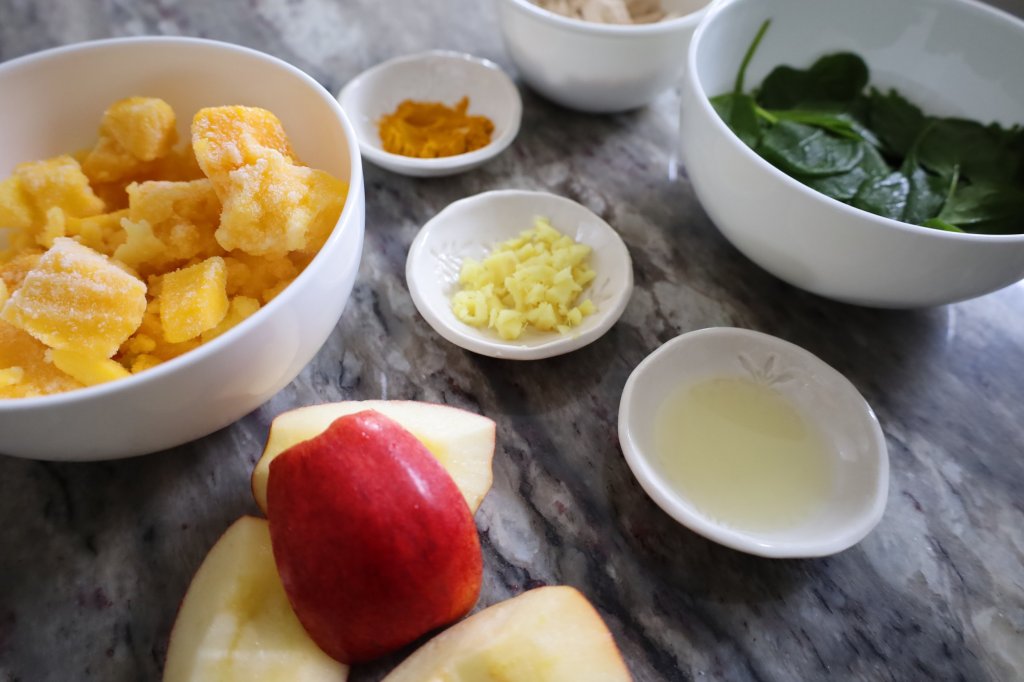
Here’s what you’ll need for this recipe:
Turmeric (ਹਲਦੀ): While the term ‘superfood’ is largely marketing jargon, there seems to be a reason our ancestors have been using turmeric for centuries. It may offer antioxidant and antimicrobial properties. I’ve also added black pepper in this recipe to help the body better absorb the active compounds in turmeric and give it another anti-inflammatory source.
Ginger (ਅਦਰਕ): I absolutely love ginger in my smoothies and while I usually add a bit too much for other family members, the amount in this smoothie is just enough to give it a bit of kick while giving it an anti-inflammatory boost.
Spinach (ਪਾਲਕ): What’s my favourite thing about spinach in smoothies? Even though you can’t taste it, you get the added benefits of fibre, vitamins, minerals, and other health-promoting nutrients.
Fruit: Along with boosting the sweetness of the smoothie, the apple (including the peel) and mango provide important nutrients like fibre, vitamins, minerals, and antioxidants.
Vegan Protein Powder: Adding a protein source really helps keep us full and meet our protein needs for the day. Protein powder is simply an easy way to get in some protein (especially if you’re using this as a post-workout smoothie), but feel free to add in other protein foods like Greek yogurt or hemp seeds if you prefer.
Kitchenware
You’ll also need:
- Blender
- Cup
- Straw (optional)

Steps
Simply add all the ingredients in a blender, blend until smooth, and enjoy!
Tips & Notes
Storage: Smoothies are best served fresh!
Substitutions: The nice thing about smoothies is that they are highly adjustable, so feel free to add, adjust, or take away any ingredients as you prefer.
Tips
- I find adding in the liquid ingredients first then adding the more solid/frozen ingredients one at a time avoids that frustrating smoothie moment where the blade is turning but the ingredients are stuck.
- A quick and easy way to clean up is too add some soap and water to the blender jug, blend on high, then rinse.
Recipe
Turmeric Ginger Green Smoothie
This refreshing plant-powered smoothie is packed with anti-inflammatory ingredients!
Ingredients
- 2 cups frozen spinach, packed
- 2 cups frozen mango chunks
- 1 apple
- 1 tbsp freshly grated ginger
- 1/2 tsp ground turmeric
- 1/8 tsp black pepper
- 1/2 cup protein powder, vanilla
- 1 cup ice
- 1 cup cold water (more as needed)
- 2-4 tbsp lemon juice
Directions
- Add all the ingredients in a blender and blend until smooth
- Pour in a cup and enjoy!
Nutrition
Per Serving: Energy/Calories: 217 kcal | Carbohydrates: 40 g | Protein: 13.9 g | Fat: 2 g | Saturated Fat: 0.5 g | Sodium: 120 mg | Fibre: 6.7 g | Total Sugars: 30 gPlease note: the nutrition information provided above is an estimation based on a reference serving size. It is subject to error/variation and is for information purposes only. The website owner is not liable for this information. While this information may be helpful for you, please remember that food is more than just numbers.
Did you make this recipe? Tag @nutrikaur on Instagram or leave a comment!
References
- Akaberi M, Sahebkar A, Emami SA. Turmeric and Curcumin: From Traditional to Modern Medicine. Adv Exp Med Biol. 2021;1291:15-39. doi: 10.1007/978-3-030-56153-6_2. PMID: 34331682.
- He Y, Yue Y, Zheng X, Zhang K, Chen S, Du Z. Curcumin, inflammation, and chronic diseases: how are they linked? Molecules. 2015 May 20;20(5):9183-213. doi: 10.3390/molecules20059183. PMID: 26007179; PMCID: PMC6272784.
- Hewlings SJ, Kalman DS. Curcumin: A Review of Its Effects on Human Health. Foods. 2017 Oct 22;6(10):92. doi: 10.3390/foods6100092. PMID: 29065496; PMCID: PMC5664031.
- Poles J, Karhu E, McGill M, McDaniel HR, Lewis JE. The effects of twenty-four nutrients and phytonutrients on immune system function and inflammation: A narrative review. J Clin Transl Res. 2021 May 27;7(3):333-376. PMID: 34239993; PMCID: PMC8259612.
- Anh NH, Kim SJ, Long NP, Min JE, Yoon YC, Lee EG, Kim M, Kim TJ, Yang YY, Son EY, Yoon SJ, Diem NC, Kim HM, Kwon SW. Ginger on Human Health: A Comprehensive Systematic Review of 109 Randomized Controlled Trials. Nutrients. 2020 Jan 6;12(1):157. doi: 10.3390/nu12010157. PMID: 31935866; PMCID: PMC7019938.
Disclaimer: All recipes on this site are intended for informational and educational purposes only. Results may vary depending on ingredients, equipment, and individual experience. Please use your best judgment and consider any allergies, dietary needs, or health conditions. The website owner is not responsible for any outcomes related to the preparation, cooking, or consumption of these recipes. Use this content at your own discretion and risk.


 nutrikaur.com
Leave a comment